Head to head · 25 specs differ
GL.iNet Beryl AX vs Slate AX
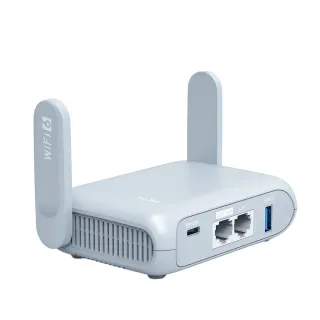 GL.iNetBeryl AXWi-Fi 6 · travel router · 2023$99.90
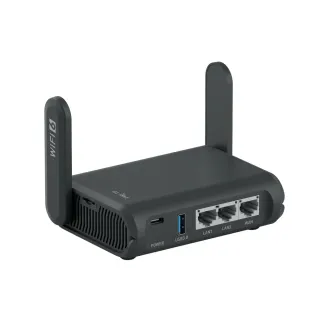 GL.iNetSlate AXWi-Fi 6 · travel router · 2022$119.99
The short answer
Buy the Beryl AX. It is $20 cheaper, has a 2.5 Gbps WAN port against the Slate AX's gigabit, carries a faster 5 GHz radio, weighs a third as much, and supports Tailscale and VLANs that the older model does not. The Slate AX is the right choice in two narrow cases: you need more than one wired LAN device, or you want the microSD slot. Its quad-core CPU also gives it a published VPN throughput figure the Beryl AX does not have — which is a reason to prefer it only if you were going to verify that number yourself anyway.
| Specification | GL.iNetBeryl AX | GL.iNetSlate AX |
|---|---|---|
| Price | ||
| Starting price | $99.90 | $119.99 |
| Wi-Fi | ||
| Wi-Fi standard | Wi-Fi 6 | Wi-Fi 6 |
| Bands | Dual-band | Dual-band |
| Speed class | AX3000 | AX1800 |
| All bands combined | 2,976 Mbps | 1,800 Mbps |
| Available to clients | 2,976 Mbpshigher | 1,800 Mbps |
| Fastest single band | 2,402 Mbpshigher | 1,200 Mbps |
| Radios | ||
| 2.4 GHz | 574 Mbps2 streams · 40 MHz | 600 Mbpshigher2 streams · 40 MHz |
| 5 GHz | 2,402 Mbpshigher2 streams · 160 MHz | 1,200 Mbps2 streams · 80 MHz |
| Wired & ports | ||
| Internet (WAN) port | 2.5 Gbpshigher | 1 Gbps |
| 2.5 Gigabit ports | 1higher | 0 |
| Gigabit ports | 1 | 3higher |
| USB ports | 1 | 1 |
| Uplink & power | ||
| Ethernet WAN | Yes | Yes |
| Wi-Fi as WAN (repeater) | Yes | Yes |
| USB tethering | Yes | Yes |
| Processor & build | ||
| Weight | 196 g | 245 g |
| Dimensions | 120 × 83 × 34 mm | 125 × 82 × 36 mm |
| Volume | 339 | 369 |
| Processor | MediaTek MT7981B dual-core 1.3 GHz | Qualcomm IPQ6000 quad-core @1.2 GHz |
| Memory | 512 MB | 512 MB |
| Storage | 256 MBhigher | 128 MB |
| Antennas | 2 | 2 |
| Features | ||
| VPN | ||
| WireGuard server | Yes | Yes |
| WireGuard client | Yes | Yes |
| OpenVPN server | Yes | Yes |
| OpenVPN client | Yes | Yes |
| Tailscale | Yes | — |
| Firmware | ||
| OpenWrt support | Yes | Yes |
| OpenWrt-based stock firmware | Yes | Yes |
| SSH access | Yes | Yes |
| Wi-Fi features | ||
OFDMAWhat is OFDMA?Table stakes50 of 79 listed here Splits a channel into smaller slices so several devices are served in the same instant instead of taking turns. Look at instead: streams per radio and channel width — those set the ceiling OFDMA divides up Full entry → | Yes | Yes |
MU-MIMOWhat is MU-MIMO?Table stakes46 of 79 listed here Lets the router hold separate conversations with several devices at once using different antenna streams. Look at instead: the stream count on each radio — a 4×4 radio has twice the streams of a 2×2 to hand out Full entry → | Yes | Yes |
DFS channelsWhat is DFS channels?Depends on your setup18 of 79 listed here Extra 5 GHz channels shared with weather and military radar, which the router must abandon the moment it hears one. Look at instead: whether your neighbourhood is actually congested, and whether the router lets you turn DFS off Full entry → | — | Yes |
160 MHz channelsWhat is 160 MHz channels?Table stakes47 of 79 listed here A double-width channel that roughly doubles throughput when the airwaves are clear enough to sustain it. Look at instead: whether the band has room for it — on 5 GHz that almost always means DFS Full entry → | Yes | — |
| Networking | ||
| WAN failover | Yes | — |
| VLAN support | Yes | — |
| Dynamic DNS | Yes | — |
| Access point mode | Yes | Yes |
| Security | ||
| WPA3 | Yes | Yes |
| DNS over HTTPS | Yes | Yes |
| DNS over TLS | Yes | Yes |
| Ad blocking | Yes | Yes |
| Management | ||
| Guest network | Yes | Yes |
| Mobile app management | Yes | Yes |
| Local web UI | Yes | Yes |
| No cloud account required | Yes | — |
| Hardware | ||
| USB storage sharing | — | Yes |
| Fanless | Yes | — |
| About | ||
| Type | Travel router | Travel router |
| Released | 2023 | 2022 |
— means the manufacturer doesn’t publish that figure. In the features rows it means the feature isn’t listed — not that the product lacks it. A No is an absence we checked.
The cheaper one is also the newer and faster one
This comparison does not have the usual shape. The Beryl AX costs $99.90 against the Slate AX's $119.99, and it wins most of the specification rows anyway:
- 5 GHz radio: 2402 Mbps against 1200 — twice the link rate, from running 160 MHz channels where the Slate AX runs 80 MHz
- WAN port: 2.5 Gbps against 1 Gbps
- Weight: 82 g against 245 g, which on a travel router is a real consideration
- Features: GL.iNet lists Tailscale, VLAN support, WAN failover, dynamic DNS and a no-cloud-account setup for the Beryl AX and not for the Slate AX. Both run the same OpenWrt-based firmware, so treat the shorter list as the older model's documentation rather than a hard capability wall
The Slate AX is the older device — 2022 against 2023 — and it is priced above the thing that replaced most of its reasons to exist.
What the Slate AX still has
Three things, and they are the whole case for it.
Ethernet ports. The Slate AX has three gigabit ports; the Beryl AX has a 2.5 Gbps WAN plus a single gigabit LAN port. If you travel with two wired devices — a work laptop and a console, say, or you are setting up in a room where the TV needs a cable — the Slate AX is simply the only one of the two that can do it without a switch in your bag.
The microSD slot. Up to 512 GB of removable storage, for media you want to share across the room's Wi-Fi. The Beryl AX has USB storage and tethering but no card slot.
More CPU cores. The Slate AX runs a quad-core Qualcomm IPQ6000 at 1.2 GHz; the Beryl AX runs a dual-core MediaTek MT7981B at 1.3 GHz. Both have 512 MB of RAM, though the Slate AX has less flash — 128 MB against 256 MB.
A note on VPN throughput
GL.iNet publishes figures for the Slate AX: up to 550 Mbps on WireGuard and 560 Mbps on OpenVPN, which is extraordinarily fast for a travel router and far more than any hotel uplink will feed it.
We do not list a comparable figure for the Beryl AX, because GL.iNet does not state one the same way. That is an absence of data, not evidence that it is slower — do not read the blank as a loss. If encrypted throughput is the deciding factor for you, the Slate AX is the one with a number attached to it, and that is genuinely all this row can tell you.
What they share
Both run GL.iNet's OpenWrt-based firmware with full OpenWrt support and SSH access, both have WireGuard and OpenVPN servers and clients, both do DNS over HTTPS and TLS, ad blocking, WPA3, access point mode, a guest network and a local web UI, and both take a single USB 3.0 port. If you are buying into GL.iNet for the software, you get the same software either way.
The honest recommendation
Buy the Beryl AX. It is cheaper, faster on the band that matters, has the better WAN port, and is dramatically more portable — which is the entire point of the category.
Buy the Slate AX if you need the second wired LAN port or the microSD slot. Those are legitimate needs, and they are the only ones that survive the $20 price difference running the wrong way.
If you were considering the Slate AX for its VPN throughput, look at the Slate 7 instead — it is the actual successor, with 2.5 Gbps ports and double the RAM.